Turning construction waste into circular value: RECONSTRUCT progress update
News releases Project update
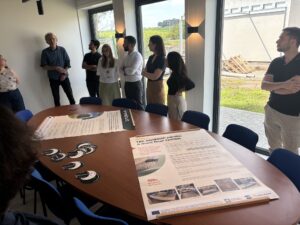
On 16 and 17 June, the RECONSTRUCT consortium gathered in Brussels for two key project milestones: the Review Meeting with the European Commission and the project’s General Assembly.
The review meeting took place at Green Energy Park, home of the Brussels Demo building, while the General Assembly was hosted the following day at the Learning and Innovation Centre (LIC) of VUB and ULB. Together, the two events provided an opportunity to reflect on three years of progress and to discuss the next steps towards delivering a circular, low-carbon construction system for Europe.
A timely contribution to Europe’s circular transition
Opening the review meeting, the Project Officer highlighted the growing relevance of projects such as RECONSTRUCT within the evolving European policy landscape: the results generated by projects help policymakers understand where critical gaps remain, identify areas requiring further investment, and determine how the EU can better support researchers, innovators, and practitioners working on the circular transition.
Against this backdrop, the consortium presented the progress achieved in the last 18 months.
Turning waste into valuable resources through AI
One of the highlights of the review focused on the detection and classification of critical raw materials contained in construction and demolition waste streams.
Researchers demonstrated how thousands of hours of CCTV footage were transformed into a sophisticated visual language model and material recognition systems capable of identifying waste with an accuracy exceeding 80%.
Accurate identification and separation of waste materials is essential for preserving their value: the data generated by these AI tools will feed the project’s waste optimisation platform, supporting more efficient material recovery and improving collaboration between stakeholders across the construction value chain.
The resulting datasets will also support Life Cycle Assessment (LCA) and Life Cycle Costing (LCC) analyses, helping quantify the environmental and economic benefits of circular construction approaches.
Developing circular concrete for real buildings
Partners also showcased the progress made in developing the innovative materials used in the demo buildings.
Partners working on circular concrete solutions shared lessons learned from designing and testing different mixes for structural and non-structural applications. Their work has focused on achieving the right balance between incorporating recycled materials and maintaining the mechanical properties required for construction, particularly compressive strength and long-term durability.
The discussions highlighted the complexity of moving from laboratory-scale innovation to real-world implementation. The next phase will focus on industrial upscaling strategies and on studying the future recyclability and reuse potential of both materials and building components.
Building a digital ecosystem for circular construction
Digitalisation remains one of the project’s central pillars.
Partners presented progress on the data ecosystem designed to track materials and components throughout their entire lifecycle. The ecosystem integrates several digital tools, including Building Material Passports, Digital Product Passports, traceability systems, and BIM-based digital twins.
Together, these solutions aim to create a comprehensive digital record of construction materials, enabling better decision-making during design, construction, maintenance, adaptation, deconstruction, and reuse phases.
Measuring circularity beyond environmental impacts
An important part of the review was dedicated to assessing how circularity can be measured in a consistent and meaningful way.
RECONSTRUCT partners and European Commission experts discussed potential future destinations for buildings similar to the project’s demonstration sites, considering how materials, components, and systems could be reused, adapted, or recycled after their first life. This work is closely linked to the project’s assessment framework, which evaluates environmental, economic, and social impacts throughout the building lifecycle.
A major challenge identified by the consortium is the absence of universally accepted methodologies for circularity assessment in the construction sector. While environmental indicators are relatively mature, social impacts remain considerably more difficult to quantify. To address this, the RECONSTRUCT team has developed a methodology based on stakeholder engagement through local Circular Construction Hubs. Workshops organised within these regional ecosystems help identify relevant indicators and ensure that assessment approaches reflect real-world needs and priorities.
The consortium has already identified seven social indicators to evaluate the societal benefits of circular construction.
Learning with stakeholders to shape future business models
The consortium also highlighted the project’s Dynamic Learning Agenda, an approach designed to ensure that knowledge generated within RECONSTRUCT remains relevant and actionable for stakeholders.
Through continuous dialogue with industry professionals, policymakers, researchers, and local communities, the consortium is validating key learning questions: What do stakeholders need to know? Which innovations are most relevant to their daily work? What barriers continue to hinder circular construction practices?
These insights will feed directly into the development of circular business models for the construction sector, helping transform technical innovations into scalable and economically viable solutions.
Seeing circularity in practice
The first day concluded with a visit to the Brussels demonstration building at Green Energy Park. Materials, digital tools, circular design principles, and reuse strategies that had been discussed throughout the day could now be observed in a real construction environment.
The following day, partners reconvened at the Learning and Innovation Centre of VUB and ULB for the General Assembly. Discussions focused on coordinating the final phase of the project, especially the next demonstration phase in Barcelona, where a new demo building will be constructed in autumn 2026 to validate the use of new alkali-activated cements, and then carefully dismantled in 2027, to enable the reuse of materials and components.
At this stage, RECONSTRUCT is entering a decisive phase in its journey. The project is moving beyond research and development towards validation, demonstration, and future replication.
As Europe accelerates its transition towards circularity, the lessons emerging from RECONSTRUCT continue to demonstrate not only what is technically possible, but also what is required to make circular construction a mainstream reality.