

Building Europe’s circular future: research meets policy
News releases
Innovative bio-based and circular construction materials are no longer a vision for the future. Across Europe, researchers and industry are proving that they can work. So why aren't they everywhere?
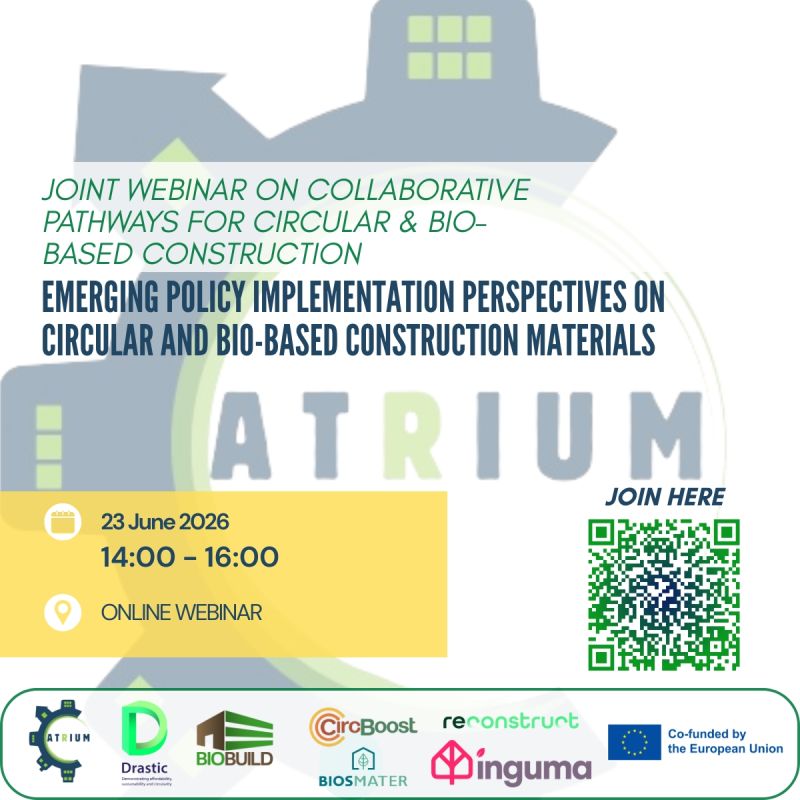
That question was at the heart of a joint webinar organised by ATRIUM project and held on 23 June, where RECONSTRUCT joined five other Horizon Europe sister projects in the CircHub cluster – BIOBUILD, INGUMA, CIRC-BOOST, DRASTIC and BIOS MATER – to explore one of the biggest challenges facing the construction sector: turning successful research into everyday practice.
The discussion brought together researchers, industry partners and representatives from the European Commission to compare experiences from their respective projects during the first part of the webinar. Despite working on different technologies and materials, participants reached a remarkably similar conclusion: the pace of innovation is no longer the main bottleneck. The real challenge is creating the conditions that allow innovation to reach the market.
Following the project presentations, Francesco Menconi (ENCO Srl) presented ATRIUM’s first Policy Brief, Emerging Findings and Policy Recommendations for Bio-based and Circular Construction Materials, and the concept of the “Proof Paradox”. Before new construction materials are widely accepted, they are expected to demonstrate years of performance, reliability and certification. Yet much of this evidence can only be collected once those same materials are actually used in buildings. It’s a vicious circle that many innovative solutions face: they need proof to enter the market, but they need the market to generate the proof.
The presentation concluded by introducing seven emerging policy guidelines intended to strengthen the enabling environment for bio-based and circular construction materials: improving regulatory harmonisation and certification pathways, promoting lifecycle-based procurement approaches, expanding demonstration and market validation activities, strengthening knowledge transfer, supporting SME scale-up, advancing circularity throughout the building lifecycle, and investing in digitalisation, interoperable data systems and future skills development.
The keynote presentation from representative from the European Commission’s Directorate-General for Research and Innovation (DG RTD) provided participants with an overview of current European policy developments relating to circular bio-based systems, industrial biotechnology and the broader European bioeconomy agenda, and emphasised how Horizon Europe projects can help inform future European policies by providing practical evidence from demonstration activities.
During the discussion, all participants agreed that future policy development should focus not only on supporting research and innovation but equally on creating the regulatory, institutional and market conditions necessary to enable wider commercial deployment of innovative construction materials.
Perhaps the strongest message to emerge from the webinar was that collaboration matters just as much as innovation. By sharing methodologies, demonstration experiences, stakeholder engagement activities and policy recommendations, sister projects are building a collective body of evidence that is far more powerful than the results of any project alone.