


If Circular Construction makes so much sense, why isn’t everyone doing it?
News releases
A new study emerging from the RECONSTRUCT project set out to answer an apparently simple question: if circular construction offers clear benefits, why does the construction industry still struggle to adopt it at scale?
The answer, according to researchers and industry professionals involved in the study, has very little to do with technology.
For years, discussions around circular construction have focused on developing innovative materials, designing buildings for disassembly, and creating digital tools to track resources throughout their lifecycle. Yet despite significant advances, demolition remains more common than deconstruction, recycled materials still compete with cheap virgin resources, and many circular solutions remain confined to pilot projects. The research suggests that the biggest obstacles are not technical, but human, organisational, and systemic.
To better understand the findings, RECONSTRUCT Communication Officer Roberta De Michele interviewed co-author Mina Najafi, researcher at the School of Computing, Engineering and Digital Technologies, Teesside University and partner in the project, to discuss why circular construction remains difficult to implement in practice and what can be done to accelerate its uptake across Europe.
Beyond technology
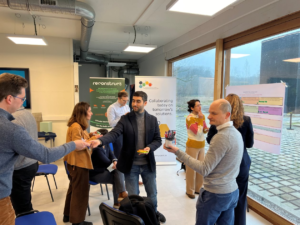
The study “User-side regime dynamics and design–use misalignments in circular construction transitions”, conducted by researchers at Teesside University, Loughborough University, Vrije Universiteit Brussel and ICONS, brought together stakeholders from across the construction value chain through workshops held in Barcelona and Brussels. Architects, engineers, contractors, manufacturers, researchers, waste managers, and policymakers were invited to discuss the barriers preventing circular solutions from becoming mainstream.
One of the strongest messages coming from the workshops was that professionals do not need more visions or strategies, they need practical tools to fill the gap between ambitious circular economy concepts and the reality of day-to-day construction projects.
Architects and engineers know they should design for reuse. Contractors understand the environmental benefits of circular materials. Building owners increasingly recognise the value of reducing waste. But knowing what should be done is not the same as knowing how to do it.
Why good principles struggle to spread
The research identified three recurring patterns that explain why circular innovations often fail to move beyond demonstration projects.
The first is what researchers call a “technology-push” problem. Innovators tend to focus on developing new solutions, while practitioners focus on making projects work within existing constraints. As a result, innovations are often designed around technological capabilities rather than real operational needs.
The second challenge is a mismatch of values. While many construction professionals support circularity in principle, projects are still evaluated primarily through cost, risk, and delivery schedules. If regulations remain unclear, insurance is difficult to obtain, or reused materials are perceived as riskier, traditional solutions often remain the safer commercial choice.
When asked which challenge emerged as the most pressing barrier to the adoption of circular construction solutions, Najafi has no doubt: “The knowledge infrastructure gap, the disconnect between conceptual understanding and operational capability appeared across every topic we explored in both Barcelona and Brussels. Practitioners understand circularity in principle, but consistently lack the practical tools, procedures, and worked examples needed to apply it in their daily work.”
The hidden barriers to reusing buildings
When taking the example of deconstruction, participants identified a range of practical barriers: deconstruction requires more planning, specialised skills, additional labour, and longer project timelines than conventional demolition. Many existing buildings were never designed to be taken apart, making recovery and reuse significantly more complex.
The result is a system where demolition continues to be easier and, in many cases, more economically attractive.
“Another example is building codes that specify performance criteria for conventional materials, without providing equivalent verification pathways for recovered components – explains Najafi, when asked about regulations that may unintentionally create barriers to circular construction. “It is not that these codes were designed to block circularity, but their silence on secondary materials can effectively do so in practice, leaving practitioners with no compliant route to specify them.”
The study highlights a series of supporting actions that could change the situation, like training, market development, new business models, and better coordination across the value chain.
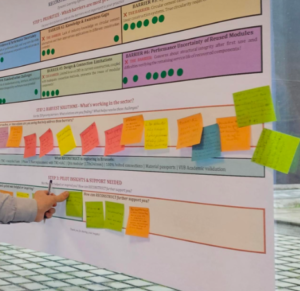
The study identifies numerous stakeholder needs, but it’s possible to identify a low-hanging fruit: making real-world performance data from demonstration projects openly available is one of the more accessible steps with significant reach. “Practitioners consistently cited uncertainty about circular materials as a barrier, although our findings suggest they often overestimate the risks; accessible, project-based evidence could help to shift perceptions” explains Najafi.
Are digital tools enough?
The RECONSTRUCT project is indeed developing a range of digital solutions, including material passports, digital product passports, and BIM-based digital twins designed to improve material information and traceability, and support circular decision-making.
Successful material reuse depends on information sharing between organisations. However, many companies remain reluctant to share data due to concerns around confidentiality, competition, and commercial advantage.
When developing digital tools, it’s crucial include in the equation governance mechanisms or incentives that could encourage companies to contribute without exposing commercially sensitive information.
“In the short term, trusted third-party data intermediaries and industry-led platforms with anonymisation protocols can offer a realistic middle ground – adds Najafi – while in the long term, regulatory frameworks that make disclosure a sector-wide standard rather than a voluntary competitive sacrifice are the more structural lever, because when transparency becomes the norm, the competitive disadvantage of sharing disappears.”
Lessons from Barcelona and Brussels
Although the workshops took place in different countries and involved different stakeholder groups, both groups arrived at the same overarching conclusion: the future of circular construction depends less on inventing new technologies and more on making existing solutions easier to adopt.
The findings point towards the importance of skills, collaboration, and practical implementation support, but also towards standards and incentives, discussing policy interventions and their practical implications. To conclude this interview, we asked our interviewee to identify the single policy change that should be prioritised by European policymakers:
“Make lifecycle value assessment mandatory and enforceable in public procurement, not just permitted. Most EU Member States already allow broader criteria beyond initial cost, but in practice, initial cost continues to dominate because evaluators lack the tools and institutional mandate to apply them. Closing that implementation gap would restructure the economic logic that currently makes linear construction the default rational choice.”
Building the conditions for circularity
For RECONSTRUCT, these findings reinforce a central lesson emerging across the project: achieving circular construction requires understanding how people work, how organisations make decisions, and how regulations, markets, and professional practices shape what becomes possible.
As Europe accelerates its transition towards a circular economy, this research offers a timely reminder that the path to transformation is not only about developing better solutions, it is about creating the conditions that allow those solutions to become the new reality.